Signed in as:
filler@godaddy.com
Improved performance even at higher altitudes.
Greater hauling even uphill or even with heavier loads.
Increased fuel efficiency causes more power without the need for a bigger engine.
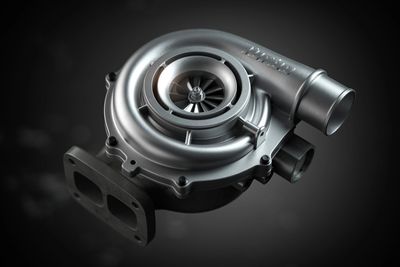
What does a Turbocharger do exactly?
Turbochargers increase the performance of your semi-trucks.
It uses exhaust gases to force more air into the truck's engine, which means more oxygen. The increase in oxygen helps your engine burn more fuel without requiring a bigger engine for the same result.
When exhaust gases exit the engine, it produces exhaust gases that are hot. Initially, this is wasted energy, but with a turbo it uses this once wasted energy.
Gases will pass over turbine blades that are from the exhaust. This turbine is located inside the turbocharger. The speed of these blades is usually over 100,000 RPMs.
The turbine itself is connected by a shaft to a compressor. This is located on the other side of the turbo. When the turbine blades spin, it powers the compressor.
With the compressor activated, it creates compressed air and forces it through the intake manifold. This compressed air contains more oxygen than regular air taken in without the use of a compressor.
Having more oxygenated air in the cylinders, the engine can inject more fuel and have more powerful combustion. This causes the engine to be able to provide more torque and horsepower. More torque and horsepower mean more ability to haul heavier loads or an easier time on upward grades.
Recognizing the signs of a failing Turbocharger on a Semi-Truck
A loss of power - if It's slow to accelerate or feels sluggish, this can mean a loss of power. This can be seen often when merging or speeding up.
Check engine light on - sometimes the check engine light will come on if there are problems with your turbocharger. This could mean issues with underboosting or overboosting.
Odd noises - if while accelerating there is a whistling or whining, it can indicate leaking seals or damaged bearings in the turbo.
Increased fuel consumption - when a turbo malfunctions the engine compensates for the loss of power by burning through more fuel.
Leaking Oil - with issues like damaged seals or bearings, this can cause oil leaks that are easily seen. It can be around the turbocharger itself or the housing.
Engine damage can occur with a blown turbocharger. This will also cause a safety hazard and make the increased turbocharger performance null when it is damaged.
Regular turbocharger diagnostics can save you the headache of the damage it can cause when it fails, and the money it will cost you to sort it out. It can cost between $2,800 - $5,300 for the total replacement cost of the turbo. This does not include lost time and work having the truck out of service, which typically can cost between $700-880 per day on average. This also does not include the additional damage the failure could have caused.
The causes of Turbocharger failure
A lack of clean, sufficient Lubrication - unclean or a lack of enough oil can cause overheating, friction, and turbo damage.
Debris - things such as dirt, dust, or generally stuff that doesn't belong can cause damage to the compressor and or the turbine.
Damaged seals - over time seals can be worn out, which can result in oil leaks. This will affect the efficiency of the turbo and cause engine issues.
Wear and tear - the turbo components can wear down over time naturally with use, but this can increase with high-speed driving and abnormal conditions.